Introduction
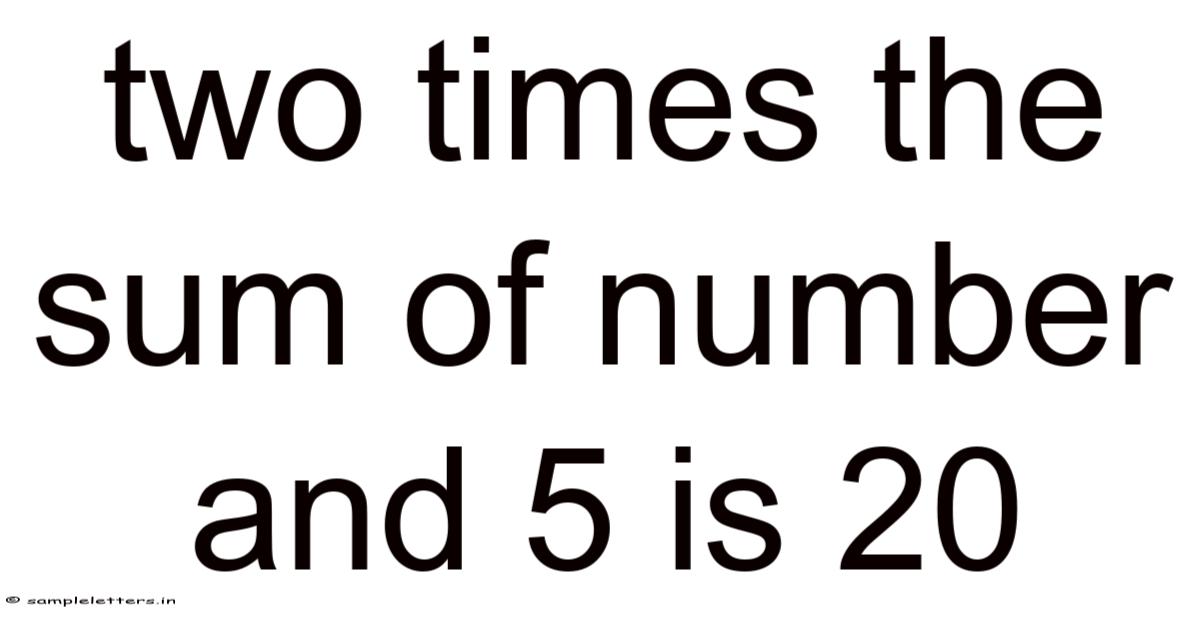
Understanding how to translate a word problem into a mathematical equation is a fundamental skill that bridges everyday language and algebraic reasoning. Worth adding: the statement “two times the sum of a number and 5 is 20” may sound simple, yet it encapsulates several core concepts: addition, multiplication, variables, and equation solving. By dissecting this sentence, we can see how mathematics captures real‑world relationships, learn a systematic approach to solving linear equations, and explore extensions that deepen our grasp of algebraic thinking. This article walks you through every step—from interpreting the phrase to checking the solution—while also highlighting common pitfalls, alternative methods, and related problems that will reinforce the concept.
Breaking Down the Phrase
1. Identify the unknown
The expression mentions “a number” without specifying its value. In algebra, we represent an unknown quantity with a variable, typically (x).
2. Recognize the operations
- “the sum of a number and 5” → addition: (x + 5)
- “two times …” → multiplication by 2: (2 \times (x + 5))
3. Translate the equality
The phrase ends with “is 20,” indicating that the entire expression equals 20. Hence the full equation becomes
[ 2,(x + 5) = 20. ]
At this point, we have turned a verbal statement into a formal algebraic equation ready for manipulation Worth keeping that in mind..
Solving the Equation Step by Step
Step 1 – Distribute the 2
Apply the distributive property (a(b + c) = ab + ac):
[ 2x + 10 = 20. ]
Step 2 – Isolate the variable term
Subtract 10 from both sides to move the constant term to the right:
[ 2x = 20 - 10 \quad\Longrightarrow\quad 2x = 10. ]
Step 3 – Solve for (x)
Divide both sides by 2:
[ x = \frac{10}{2} = 5. ]
Thus, the number is 5 Simple as that..
Verification – Why Checking Matters
After obtaining a solution, it is good practice to substitute it back into the original statement:
[ 2,(5 + 5) = 2 \times 10 = 20, ]
which matches the right‑hand side of the equation. The verification confirms that (x = 5) satisfies the condition, eliminating any chance of algebraic slip‑ups.
Common Mistakes and How to Avoid Them
| Mistake | Why It Happens | Correct Approach |
|---|---|---|
| Forgetting parentheses | Treating “two times the sum” as (2x + 5) instead of (2(x+5)) | Always write the sum inside parentheses before multiplying. So |
| Dividing only the constant term | Doing (2x + 10 = 20 \Rightarrow 2x = 10) correctly, but then dividing 10 by 2 and leaving the 2 untouched | Apply the same operation to both sides of the equation. |
| Sign errors when moving terms | Mis‑reading “subtract 10” as “add 10” | Write each step explicitly: (2x + 10 - 10 = 20 - 10). |
| Skipping verification | Assuming the solution is correct without testing | Plug the value back into the original expression every time. |
Being vigilant about these pitfalls strengthens algebraic fluency and builds confidence for more complex problems Small thing, real impact..
Extending the Concept
1. Changing the coefficients
Suppose the sentence reads: “Three times the sum of a number and 7 is 45.”
The equation becomes (3(x + 7) = 45). Following the same steps yields
[ 3x + 21 = 45 \Rightarrow 3x = 24 \Rightarrow x = 8. ]
The pattern remains identical: translate, distribute, isolate, solve The details matter here..
2. Introducing a second unknown
Consider: “Two times the sum of a number and 5 equals the sum of 3 and twice another number.”
Let the first unknown be (x) and the second be (y). The equation reads
[ 2(x + 5) = 3 + 2y. ]
Now we have a relationship between two variables. Solving requires an additional equation or a condition (e.And g. , “the numbers are equal”). This illustrates how a simple structure can evolve into a system of linear equations.
3. Real‑world applications
- Finance: If a bank offers a promotion where “twice the sum of your deposit and a $5 bonus equals $20,” the required deposit is $5.
- Cooking: A recipe states “twice the sum of a cup of ingredient A and 5 grams of spice yields 20 grams of mixture.” Solving tells you how much of ingredient A you need.
These scenarios demonstrate that the abstract algebraic form models tangible situations.
Frequently Asked Questions
Q1. Why do we use parentheses in the equation?
Parentheses indicate that the addition inside must be performed before the multiplication, reflecting the order described in the original phrase. Without them, the meaning changes dramatically And that's really what it comes down to..
Q2. Can I solve the problem without distributing?
Yes. After writing (2(x + 5) = 20), you can first divide both sides by 2:
[ x + 5 = 10 \quad\Rightarrow\quad x = 5. ]
Both methods are valid; the choice depends on personal preference or the complexity of the expression.
Q3. What if the result is a fraction?
If the numbers do not divide evenly, the solution will be a rational number. Take this: “two times the sum of a number and 4 is 15” leads to
[ 2(x + 4) = 15 \Rightarrow x + 4 = 7.5 \Rightarrow x = 3.5 Turns out it matters..
The process remains unchanged; the answer may simply be a decimal or fraction.
Q4. How does this relate to solving inequalities?
If the statement were “two times the sum of a number and 5 is at least 20,” we would write
[ 2(x + 5) \ge 20, ]
and solving yields (x \ge 5). The same algebraic steps apply, but the final answer is a range rather than a single value.
Q5. Is there a graphical way to see the solution?
Plotting the left‑hand side function (y = 2(x + 5)) and the constant line (y = 20) on a coordinate plane shows they intersect at (x = 5). The intersection point visually confirms the solution No workaround needed..
Practice Problems
- Two times the sum of a number and 3 equals 26. Find the number.
- Three times the sum of a number and 2 is 27. Determine the number.
- Four times the sum of a number and 6 is 40. What is the number?
- Two times the sum of a number and 5 is greater than 20. Write the inequality and solve for the number.
Working through these will reinforce the translation‑to‑equation process and the systematic solving steps.
Conclusion
The statement “two times the sum of a number and 5 is 20” serves as a compact illustration of how everyday language can be expressed mathematically, solved, and verified. By identifying the unknown, applying the correct order of operations, and methodically isolating the variable, we discovered that the hidden number is 5. The journey from words to symbols not only yields a numeric answer but also cultivates logical reasoning, attention to detail, and confidence in handling more detailed algebraic challenges.
Remember the key takeaways:
- Translate precisely—use parentheses to preserve the intended grouping.
- Apply the distributive property or simplify by dividing first; both paths lead to the same result.
- Check your work by substituting the solution back into the original sentence.
Mastering this simple yet powerful pattern opens the door to solving a wide spectrum of linear equations, from classroom exercises to real‑world problems in finance, science, and everyday decision‑making. Keep practicing, and soon the translation from English to algebra will become an intuitive, second‑nature skill Not complicated — just consistent..
