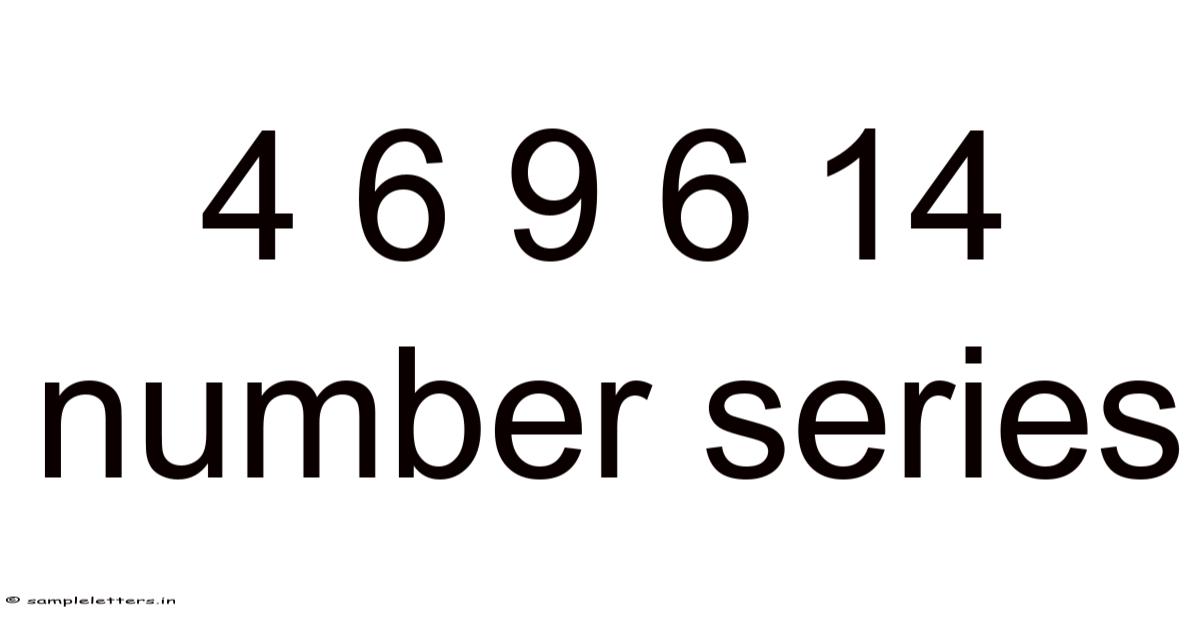
4 6 9 6 14 number series: Uncovering the Hidden Pattern
Once you first glance at the sequence 4, 6, 9, 6, 14, it may look like a random collection of numbers. Understanding how to decode such patterns is a valuable skill—not only for math enthusiasts but also for anyone who enjoys logical puzzles, coding challenges, or standardized‑test preparation. And yet, a closer inspection reveals a simple but elegant rule that governs the progression. In this article we will walk through the process of identifying the rule behind the 4 6 9 6 14 number series, explain why it works, explore alternative interpretations, and show how similar reasoning can be applied to other sequences.
Understanding the Pattern
The key to solving many number‑series puzzles lies in separating the sequence into manageable parts. One effective strategy is to examine the positions (odd vs. even) of each term.
| n (position) | Term |
|---|---|
| 1 | 4 |
| 2 | 6 |
| 3 | 9 |
| 4 | 6 |
| 5 | 14 |
Notice something interesting: the odd‑indexed terms (1st, 3rd, 5th) are 4, 9, 14, while the even‑indexed terms (2nd, 4th) are both 6. This observation immediately suggests two interleaved sub‑sequences:
- Odd positions: 4 → 9 → 14 → …
- Even positions: 6 → 6 → 6 → …
If we can describe each sub‑sequence with a simple rule, we have uncovered the pattern for the whole series Worth keeping that in mind..
Step‑by‑Step Identification
Below is a systematic approach you can follow whenever you encounter a puzzling number series.
1. Write the terms with their indices
n:  1   2   3   4   5
a:  4   6   9   6  14
2. Look for regularities in differences or ratios
- First differences (aₙ₊₁ − aₙ): +2, +3, −3, +8
These do not form a clear arithmetic or geometric progression. - Second differences (difference of the first differences): +1, −6, +11
Still irregular.
When differences fail to reveal a pattern, consider splitting the series.
3. Separate odd and even indices
- Odd‑indexed terms: 4, 9, 14 …
- Even‑indexed terms: 6, 6, 6 …
4. Analyse each sub‑sequence independently
-
Odd sub‑sequence:
9 − 4 = 5, 14 − 9 = 5 → constant difference of +5.
This is an arithmetic progression with first term a₁ = 4 and common difference d = 5.
Formula: a₍₂ₖ₊₁₎ = 4 + 5k, where k = 0, 1, 2,… -
Even sub‑sequence:
Every term equals 6, i.e., a constant sequence.
Formula: a₍₂ₖ₎ = 6 for all k ≥ 1.
5. Re‑combine the sub‑sequences
Plugging
these two rules back together, we can reconstruct the original series:
- Position 1 (Odd): $4$
- Position 2 (Even): $6$
- Position 3 (Odd): $4 + 5 = 9$
- Position 4 (Even): $6$
- Position 5 (Odd): $9 + 5 = 14$
The logic is consistent and predictable. Still, following this logic, we can easily predict the next few terms. The 6th term (even) will be 6, and the 7th term (odd) will be $14 + 5 = \mathbf{19}$ Still holds up..
Alternative Interpretations
While the interleaved sequence is the most straightforward explanation, experienced puzzle solvers often look for alternative rules to ensure the pattern isn't a coincidence. Take this: one might look for a polynomial fit or a recursive formula where each term depends on the one before it.
One could hypothesize a rule based on alternating operations:
- $4 + 2 = 6$
- $6 + 3 = 9$
- $9 - 3 = 6$
- $6 + 8 = 14$
Even so, the sequence of operations ($+2, +3, -3, +8$) lacks a clear internal logic compared to the elegance of the interleaved constant and arithmetic progressions. In competitive testing and logical reasoning, the simplest explanation that fits all given data points is typically the intended answer Worth knowing..
Applying This Logic to Other Sequences
The "interleaving" technique is a powerful tool for decoding many complex series. You will often find this structure in patterns where the numbers seem to "bounce" or fluctuate wildly. Whenever you see a sequence that increases and decreases in a rhythmic fashion, try these steps:
- Check for "Oscillation": If the numbers go up, then down, then up again, it is a strong signal that you are dealing with two or more combined series.
- Test for Multiple Strands: If splitting by odd/even doesn't work, try splitting the series into three groups (1st, 4th, 7th; 2nd, 5th, 8th; 3rd, 6th, 9th).
- Verify the Constant: Look for a "static" term (like the 6 in our example) that acts as an anchor, allowing you to isolate the moving parts of the puzzle.
Conclusion
The 4 6 9 6 14 series serves as a perfect example of how a seemingly random set of numbers can be dismantled through systematic analysis. By shifting the perspective from a single linear progression to two parallel sub-sequences, a complex problem becomes a simple matter of basic addition and constant values. Mastering this ability to "deconstruct" a sequence allows you to approach logical challenges with a structured methodology rather than guesswork, turning a frustrating puzzle into a solvable equation. Whether you are preparing for a technical interview or simply sharpening your mind, the key is to look beyond the surface and seek the hidden structure within.
