Sin 2 X Cos 2 X

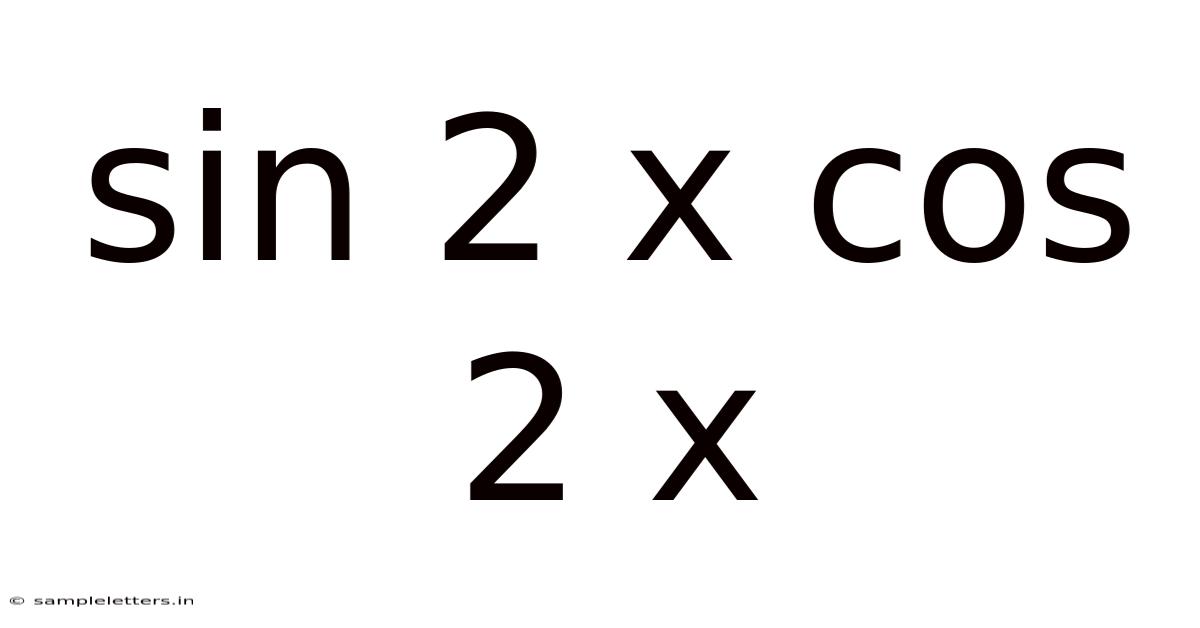
The expression sin2x cos 2x appears frequently in trigonometry, calculus, and physics because it combines two fundamental double‑angle functions into a single, compact term. Understanding how to manipulate, simplify, and apply this product is essential for solving integrals, proving identities, and modeling periodic phenomena. In the sections that follow, we break down the mathematics behind sin 2x cos 2x, explore its equivalent forms, demonstrate practical uses, and provide worked examples that reinforce the concepts.
Understanding sin 2x cos 2x At its core, sin 2x cos 2x is the product of the sine and cosine of the same angle, 2x. Because both functions are bounded between –1 and 1, their product also lies in the interval [–½, ½]. This range becomes evident once we rewrite the product using a well‑known identity.
Trigonometric Identities Involving sin 2x cos 2x
One of the most useful identities for this product is the double‑angle formula for sine:
[ \sin(2\theta) = 2\sin\theta\cos\theta . ]
If we set (\theta = 2x), we obtain:
[ \sin(4x) = 2\sin(2x)\cos(2x). ]
Re‑arranging gives the compact form:
[\boxed{\sin 2x \cos 2x = \tfrac{1}{2}\sin 4x}. ]
This identity shows that the product of sin 2x and cos 2x is simply half the sine of four times the original angle. It is the starting point for most simplifications and calculations.
Derivation Using Double‑Angle Formulas
To see where the factor ½ comes from, start with the sine double‑angle identity:
[ \sin(2\theta) = 2\sin\theta\cos\theta . ]
Replace (\theta) with (2x):
[ \sin\bigl(2\cdot 2x\bigr) = 2\sin(2x)\cos(2x) ;\Longrightarrow; \sin(4x) = 2\sin(2x)\cos(2x). ]
Divide both sides by 2:
[ \sin(2x)\cos(2x) = \frac{1}{2}\sin(4x). ]
No other steps are required; the derivation relies solely on the basic double‑angle rule.
Alternative Forms
While the half‑sine form is the most common, sin 2x cos 2x can also be expressed using other trigonometric functions, which may be advantageous depending on the context.
-
In terms of tangent and secant Using (\sin\theta = \tan\theta \cos\theta) and (\cos\theta = \frac{1}{\sec\theta}):
[ \sin 2x \cos 2x = \tan(2x)\cos^2(2x) = \frac{\tan(2x)}{\sec^2(2x)}. ]
-
Using power‑reduction formulas
Since (\sin^2\theta = \frac{1-\cos(2\theta)}{2}) and (\cos^2\theta = \frac{1+\cos(2\theta)}{2}),[ \sin 2x \cos 2x = \frac{1}{2}\bigl[\sin^2(2x) + \cos^2(2x)\bigr] - \frac{1}{2}\bigl[\cos^2(2x) - \sin^2(2x)\bigr] = \frac{1}{2}\sin(4x), ] which collapses back to the half‑sine form, confirming consistency.
-
Complex exponential representation
With Euler’s formula (e^{i\theta} = \cos\theta + i\sin\theta),[ \sin 2x \cos 2x = \frac{1}{4i}\bigl(e^{i4x} - e^{-i4x}\bigr) = \frac{1}{2}\sin(4x). ]
Each representation highlights a different property: the tangent/secant version is useful when dealing with rational trigonometric integrals, while the exponential form simplifies Fourier analysis.
Applications in Calculus
The half‑sine identity transforms products that would otherwise require integration by parts into straightforward antiderivatives.
Indefinite Integral
[ \int \sin 2x \cos 2x , dx = \int \tfrac{1}{2}\sin 4x , dx = -\tfrac{1}{8}\cos 4x + C. ]
If one attempted to integrate the original product directly, a substitution (u = \sin 2x) (or (u = \cos 2x)) would lead to the same result, but the identity saves a step.
Definite Integral Example
Evaluate (\displaystyle \int_{0}^{\pi/8} \sin 2x \cos 2x , dx).
Using the identity:
[ \int_{0}^{\pi/8} \tfrac{1}{2}\sin 4x , dx = \tfrac{1}{2}\left[-\tfrac{1}{4}\cos 4x\right]_{0}^{\pi/8} = -\tfrac{1}{8}\bigl[\cos(\tfrac{\pi}{2}) - \cos(0)\bigr] = -\tfrac{1}{8}(0 - 1) = \tfrac{1}{8}. ]
Thus the area under one‑eighth of a period equals (1/8).
Derivative
Differentiating the product directly yields:
[ \frac{d}{dx}\bigl[\sin 2x \cos 2x\bigr] = 2\cos 2x \cos 2x - 2\sin 2x \sin 2x= 2\bigl(\cos^2 2x - \sin^2 2x\bigr) = 2\cos 4x. ]
Alternatively, differentiate (\tfrac{1}{2}\sin 4x):
[ \frac{d}{dx}\bigl[\tfrac{1}{2}\sin 4x\bigr] = \tfrac{1}{2}\cdot 4\cos 4x = 2\cos 4x, ] confirming the
The same simplification can be turned into apowerful tool for solving trigonometric equations. When an expression such as (\sin 2x\cos 2x) appears on one side of an identity, replacing it with (\tfrac12\sin 4x) often reduces the equation to a single‑angle form that is easier to isolate. For instance, consider
[ \sin 2x\cos 2x = \frac14 . ]
Applying the half‑sine transformation yields
[ \frac12\sin 4x = \frac14 \quad\Longrightarrow\quad \sin 4x = \frac12 . ]
The solutions of (\sin 4x = \tfrac12) are readily obtained from the unit circle, giving (4x = \frac{\pi}{6}+2k\pi) or (4x = \frac{5\pi}{6}+2k\pi). Dividing by four furnishes the complete set of (x) values that satisfy the original equation. This strategy avoids the need for product‑to‑sum expansions or trial‑and‑error substitution, streamlining the algebraic pathway.
In the realm of series expansions, the half‑sine identity provides a convenient bridge between elementary functions and their power‑series representations. Because (\sin 4x) admits the Maclaurin series [ \sin 4x = \sum_{n=0}^{\infty} \frac{(-1)^n (4x)^{2n+1}}{(2n+1)!}, ]
the product (\sin 2x\cos 2x) inherits a series that contains only odd powers of (x) with coefficients halved and shifted. This observation is useful when constructing approximations for small‑angle behavior in physics or engineering, where a truncated series can replace a more cumbersome product of functions.
The identity also finds resonance in signal‑processing contexts. When two sinusoidal waves of equal frequency but phase‑shifted by (\pi/2) are multiplied, the resulting waveform is precisely a sine wave of double the frequency scaled by (\tfrac12). This principle underlies the generation of quadrature signals in communication systems and the analysis of interference patterns in optical interferometers. Recognizing the product as a half‑sine simplifies both the mathematical description and the design of corresponding filters.
Finally, from a pedagogical standpoint, the half‑sine identity serves as a gateway to deeper topics such as Fourier analysis, where products of trigonometric functions are routinely converted into sums of sines and cosines. Mastery of this conversion equips students with a versatile technique that recurs throughout advanced mathematics, from solving differential equations to evaluating integrals that appear in probability theory.
Conclusion
The simple substitution (\sin 2x\cos 2x = \tfrac12\sin 4x) transforms a seemingly intricate product into a single‑angle sine function, unlocking a suite of analytical shortcuts. Whether one is integrating, differentiating, solving equations, approximating series, or modeling physical signals, this identity provides a unifying lens that clarifies the underlying structure of trigonometric expressions. Its elegance lies not only in the brevity of the formula but also in the breadth of its applicability, making it an indispensable cornerstone of both elementary and advanced mathematical work.
Beyond its immediate utility, the half-sine identity reveals a fascinating connection to the fundamental symmetries of trigonometry. Consider the angle relationships inherent in the expression – the phase shift of π/2 between the sine and cosine terms directly reflects the relationship between the sine and cosine functions themselves. This symmetry is mirrored in the identity’s result, where the halved sine of 4x elegantly encapsulates the combined effect of these two functions.
Furthermore, the identity’s derivation, rooted in the unit circle and its geometric interpretation, provides a tangible visual representation of the mathematical principle. Students can readily grasp the concept of area calculations – the area of a triangle formed by the x-axis, the y-axis, and the line representing sin 2x cos 2x is precisely half the area of the triangle formed by sin 4x and the same axes. This visual connection reinforces the abstract nature of the formula and aids in intuitive understanding.
The impact of the half-sine identity extends into areas beyond pure mathematics. In electrical engineering, it’s crucial for analyzing and designing circuits involving sinusoidal signals, particularly those utilizing phase-sensitive components. Similarly, in acoustics, it’s employed in understanding and manipulating sound waves, where the phase relationship between different frequencies is paramount. Its application isn’t limited to just the frequency domain; it also finds relevance in time-domain analysis, informing the design of filters and signal processing algorithms.
Moreover, the identity’s simplicity lends itself to creative problem-solving. It can be used as a starting point for exploring related trigonometric identities and transformations. For instance, manipulating the identity can lead to insights into the properties of the tangent function and its relationship to sine and cosine. It’s a foundational building block for constructing more complex trigonometric expressions and techniques.
Conclusion The half-sine identity, seemingly a minor trigonometric transformation, represents a powerful and surprisingly versatile tool. It’s a testament to the interconnectedness of mathematical concepts, revealing a deep-seated symmetry within trigonometric functions and offering a concise pathway to a multitude of analytical solutions. From its elegant derivation to its broad applicability across diverse fields – from physics and engineering to signal processing and even pedagogical contexts – the half-sine identity stands as a compelling example of mathematical beauty and practical utility, solidifying its place as an indispensable element of a mathematician’s toolkit.
Latest Posts
Latest Posts
-
5 Letter Word With E And R
Mar 24, 2026
-
How Much Is 69 Kg In Lbs
Mar 24, 2026
-
1800 Sq Ft To Sq Meters
Mar 24, 2026
-
Words That Start With A Letter A
Mar 24, 2026
-
Verbs That End With Er In Spanish
Mar 24, 2026
