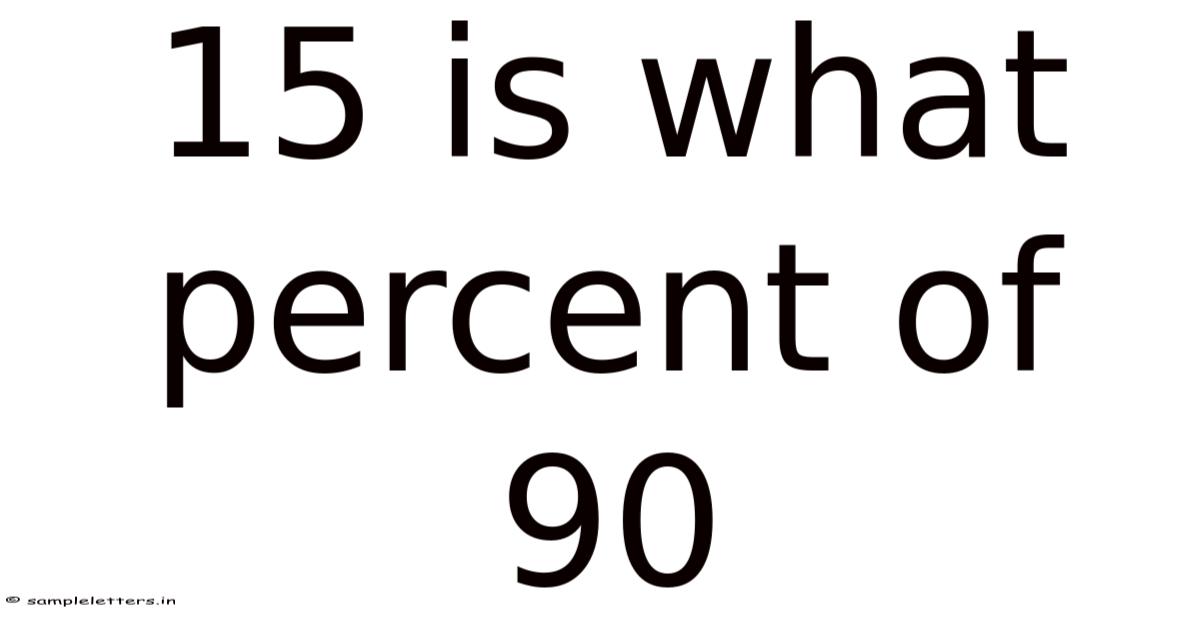
15 is what percent of 90 represents a foundational concept that permeates countless aspects of daily life, education, economics, and even technology. Even so, through structured analysis and real-world examples, we will uncover how 15% of 90 serves as a versatile building block for quantifying various scenarios, whether in calculating discounts, assessing market shares, or analyzing growth rates. By examining this relationship closely, we uncover not only the mathematical foundation but also the underlying principles that govern how percentages function as a universal language within quantitative discourse. This article delves deeply into the mechanics of percentage calculation, explores its practical applications across diverse fields, and examines why mastering this skill is indispensable in both personal and professional contexts. In real terms, understanding how to translate raw numbers into meaningful proportions is essential for navigating financial decisions, interpreting statistics, or grasping statistical trends that influence societal structures. Here's the thing — while the numerical relationship may seem straightforward at first glance, unpacking the precise calculation of this percentage reveals its significance beyond mere arithmetic. Practically speaking, the process itself becomes a gateway to deeper comprehension, bridging the gap between abstract numerical values and tangible outcomes. This exploration will guide readers through the intricacies of percentage computation while emphasizing its pervasive relevance, ensuring that the reader leaves with a dependable understanding of how such a simple calculation can profoundly impact decision-making processes That's the part that actually makes a difference..
H2: The Significance of Percentages in Modern Life
In today’s data-driven world, percentages act as a critical bridge between numbers and actionable insights. Day to day, they allow individuals and organizations to distill complex datasets into digestible forms, enabling clearer communication of trends, efficiencies, and efficiencies. Even so, understanding these metrics is crucial for making informed choices, whether purchasing resources, allocating budgets, or evaluating project outcomes. On the flip side, the ability to convert percentages into percentages themselves—or more broadly, comprehend their relative weight—becomes a skill that enhances analytical precision. This versatility underscores their foundational role in decision-making processes that shape both personal and collective futures. To give you an idea, when analyzing sales figures, businesses often rely on percentages to identify growth percentages, while educators might use them to assess test scores or student performance metrics. Beyond that, percentages serve as a universal standard across disciplines, offering a common framework for comparing disparate data points. Whether calculating interest rates, assessing risk factors, or tracking inflation rates, percentages provide a consistent reference point that simplifies interpretation. In real terms, the precision required to apply percentages accurately also necessitates a commitment to accuracy, fostering a mindset where attention to detail becomes key. Thus, grasping the concept of percentage calculation is not merely about computation but about cultivating a nuanced perspective that informs choices rooted in quantitative reality.
H3: Breaking Down the Calculation Process
Calculating what percent of 90 equals 15 involves a straightforward yet precise mathematical operation: multiplying the desired value by its proportion relative to the whole. In this case, 15% of 90 translates to 15 divided by 100 multiplied by 90, yielding 13.On top of that, 5. That's why this computation is straightforward, yet its execution demands careful attention to avoid common pitfalls such as miscalculations or misinterpretations. Here's a good example: confusing percentage points with ratios or misapplying decimal equivalents can lead to significant errors. To ensure accuracy, one must first confirm the definition of percentage—expressing a portion as a fraction of a whole—and then apply the formula: (Part/Whole) × 100. Now, breaking down the formula into its components helps demystify the process: identifying the part (15), dividing it by the whole (90), scaling it up by 100 to obtain the percentage. Consider this: visual aids such as pie charts or bar graphs can further illustrate this concept, allowing learners to grasp how percentages manifest in real-world contexts. Additionally, practicing similar calculations with varying numbers reinforces understanding and builds confidence in applying the method consistently And it works..
Building confidence through consistent practice is essential. Employing estimation techniques beforehand provides a valuable sanity check; for instance, knowing that 10% of 90 is 9, and 20% would be 18, immediately signals that 15% (13.Still, " or "45 is what percent of 60? To build on this, developing an awareness of common errors—such as misplacing the decimal point, incorrectly identifying the part and the whole, or confusing percentage increase/decrease calculations—is crucial for accuracy. Tackling problems like "what percent of 120 is 36?" solidifies the core formula application. 5) falls logically between these values.
Worth pausing on this one The details matter here..
H3: Beyond the Basics: Applications and Implications
Mastery of percentage calculation extends far beyond simple academic exercises. It underpins critical financial literacy: understanding interest rates on loans or savings accounts, calculating discounts during sales, determining tax amounts, and comprehending investment returns or stock market fluctuations. Even in everyday life, from reading nutrition labels showing daily value percentages to understanding statistical data presented in news reports, this skill empowers individuals to engage with information critically and make sound judgments based on quantitative evidence. Still, healthcare professionals rely on percentages to interpret lab results, understand medication dosages, and track patient recovery rates or disease prevalence. In scientific research, percentages are indispensable for expressing experimental results, error margins, and statistical significance, allowing researchers to communicate findings clearly and compare results across studies. The ability to confidently calculate and interpret percentages transforms raw data into actionable insights Turns out it matters..
H3: Conclusion
At the end of the day, the seemingly simple calculation of "what percent of 90 is 15?" serves as a gateway to a fundamental skill with vast real-world significance. It encapsulates the core principle of expressing a part relative to a whole, a concept universally applied across disciplines and daily scenarios. Here's the thing — while the mechanics involve a clear formula—(Part / Whole) × 100—the true value lies in the precision, critical thinking, and practical application it fosters. Practically speaking, from navigating personal finances to interpreting complex data, making informed decisions, and communicating effectively in a quantitative world, percentage literacy is indispensable. Think about it: it equips individuals with the analytical tools to dissect information, evaluate risks, recognize opportunities, and ultimately participate more meaningfully in an increasingly data-driven society. That's why, mastering percentage calculation is not merely an academic exercise; it is a vital competency for navigating and succeeding in the modern world.
